😃 Subscribe for Post Emails:
Oct 6:
MCS & Story Development,
Writing Process & Planning,
Chapters & Openings
Pantsers Flail, Plotters Prevail: One Column with Three Keys to Unlock Your Plot
Sep 22:
MCS & Story Development,
Writing Process & Planning
Sketch Your Next Novel Our Way; Get Started in One Day
Sep 8:
MCS & Story Development,
Writing Process & Planning,
Feedback & Retelling
Good Spiraling: Conscientiously Add Ideation and Feedback to Write Better Novels
Aug 25:
MCS & Story Development,
Writing Process & Planning
Once Upon a Time? What Fairy Tales Teach Novelists About Memory and Writing
Aug 11:
Writing Process & Planning,
Chapters & Openings
Part 3: Mastering the 100,000-Word Novel Budget: Multivalue Paragraphs
Jul 28:
Writing Process & Planning,
Chapters & Openings
Part 2: Mastering the 100,000-Word Novel Budget: Satisfying Chapters
Jul 14:
MCS & Story Development,
Writing Process & Planning,
Chapters & Openings
Part 1: How to Master the 100,000-Word Novel Budget and Make Every Word Count
Jun 30:
Feedback & Retelling,
Writer Personas,
Mindset & Motivation
Isolation's Impact: Evidence that Authors Misjudge Their Work
Jun 16:
MCS & Story Development,
Chapters & Openings,
Feedback & Retelling
Unlocking Story Sense: The Differentiator Between Good and Great Authors
Jun 2:
Contests & Anthologies,
Publishing & Career
Creation vs. Generation: Drawing a Non-technical Red Line Between Human Authorship and AI
May 19:
Marketing & Promotion,
Publishing & Career
Author Bio: From Bore to Brand with an Irresistible Tidbit in 6 Steps
May 5:
Marketing & Promotion,
Publishing & Career
Five Steps to a better Novel Cover: The A.T.E. Roadmap
Apr 21:
Marketing & Promotion,
Publishing & Career
Writers as Solepreneurs: Why Finishing your Novel Opens the Best Door to a Rewarding Business
Apr 14:
Marketing & Promotion,
Publishing & Career
How Authors Can Succeed During Economic Downturns
Apr 8:
MCS & Story Development,
Writing Process & Planning,
Publishing & Career
Have Sales Chase You: Select Writing Projects with Passion and Potential
Mar 25:
Writing Process & Planning,
Chapters & Openings,
Feedback & Retelling
The Art of Orientation: Anchoring Your Reader at Every Chapter Break
Mar 11:
Feedback & Retelling,
Writer Personas,
Mindset & Motivation
How to Cultivate "Healthy Arrogance": Part 2: The Confidence You Need to Break Through as a Novelist
Feb 25:
Feedback & Retelling,
Writer Personas,
Mindset & Motivation
How to Cultivate "Healthy Arrogance": Part 1: What Not to Do
Feb 11:
MCS & Story Development,
Writing Process & Planning,
Feedback & Retelling
Stop Writing in a Straight Line: The Power of Nonlinear Novel Development
Jan 29:
Writing Process & Planning,
Feedback & Retelling
The Waiter Problem: Why Authors Need True Product Testing
Jan 15:
MCS & Story Development,
Writing Process & Planning,
Publishing & Career
Separability Secrets: Why Subpar Prose Sells & 3 Ways that Helps Your Novels
Dec 10:
MCS & Story Development,
Characters
Create Authentic, Investable Characters: A Free Comprehensive Online Developer
Dec 3:
MCS & Story Development,
Writing Process & Planning
How to Crystallize Your Novel’s Narrative: The 4 Stages of the Minimum Complete Story
Nov 12:
MCS & Story Development,
Writing Process & Planning,
Marketing & Promotion
The 9-Sentence Novel: How to Build a Minimum Complete Story (MCS)
Nov 5:
MCS & Story Development,
Writing Process & Planning,
Feedback & Retelling
Our Minimum Complete Story (MCS): Better Novels in 90 Seconds
Oct 29:
MCS & Story Development,
Characters
Example Character: Meet Pat the Firefighter
Oct 22:
MCS & Story Development,
Characters
Character Recipe Step 2: Blend Your Equation Ingredients to Relatable Beings
Oct 16:
MCS & Story Development,
Characters
Character Equation Three: Steal Distinctiveness from Referents You Know
Oct 9:
Feedback & Retelling,
Marketing & Promotion,
Publishing & Career
Turn Readers into Superfans: Build Two-Way Connections
Oct 1:
MCS & Story Development,
Characters
Character Equation Two: Take Advantage of Readers' Cultural Knowledge
Sep 23:
MCS & Story Development,
Characters
Character Equation One: Steal Parts of Yourself For A Publishable Character
Sep 17:
Feedback & Retelling,
Publishing & Career
The Publishability Index™: A Checklist for Your Story
Sep 11:
Chapters & Openings,
Feedback & Retelling,
Contests & Anthologies
Four Musts for Compelling First Chapters
Sep 4:
Writer Personas,
Mindset & Motivation
What's Your Writer Persona? Message Morgan
Aug 28:
Writer Personas,
Mindset & Motivation,
Publishing & Career
What's Your Writer Persona? Grandiose Gary
Aug 21:
Writer Personas,
Mindset & Motivation,
Publishing & Career
What's Your Writer Persona? Publication Pat
Aug 7:
Writer Personas,
Mindset & Motivation
What's Your Writer Persona? Motivation Max
Jul 30:
Writer Personas,
Mindset & Motivation
What's Your Writer Persona? Learning Logan
Jul 9:
MCS & Story Development,
Writing Process & Planning
Bardsy's MCS: A Small Story That Makes a Big Difference
Jun 25:
Chapters & Openings,
Feedback & Retelling
How to Hook Your Readers (and Keep Them) via Commonality
Jun 11:
Mindset & Motivation,
Publishing & Career
Stories, Sweat, and Tears: 6 Tips for Writers Dealing with Rejection
Jun 4:
Feedback & Retelling,
Marketing & Promotion
Effectively Using Beta Readers in 2025
May 21:
Writing Process & Planning,
Mindset & Motivation
Have Something to Show for Your Summer
May 15:
Writing Process & Planning,
Feedback & Retelling
A Guide to Bardsy's Directed Writing Groups
Apr 24:
Writing Process & Planning,
Feedback & Retelling,
Mindset & Motivation
What Can a Writing Coach Do for You?
Feb 23:
Mindset & Motivation,
Contests & Anthologies,
Publishing & Career
Thanks, but No Thanks: When Your Writing Gets Rejected
Feb 16:
Writing Process & Planning,
Feedback & Retelling,
Contests & Anthologies
Winning Revisions: Making Writing Feedback Work for You
Feb 5:
Writing Process & Planning,
Feedback & Retelling
Collecting Writing Feedback You Can Actually Use
Jan 22:
Chapters & Openings,
Feedback & Retelling,
Contests & Anthologies
Is My First Chapter a Winner?
Jan 15:
Marketing & Promotion,
Publishing & Career
Social Media for Authors: A Marketing Mindset
Dec 30:
Marketing & Promotion,
Publishing & Career
But I Don't Want to be an Influencer . . . Social Media for Authors
Dec 18:
Writer Personas,
Mindset & Motivation,
Publishing & Career
What's Your Writer Persona? Hobbyist Hayden + Career Cary
Dec 10:
Feedback & Retelling,
Writer Personas,
Mindset & Motivation
What's Your Writer Persona? Social Sam
Jun 12:
Writing Process & Planning,
Writer Personas,
Mindset & Motivation
Planning Your Success: We're Here to Help!
Jun 5:
Feedback & Retelling,
Contests & Anthologies,
Publishing & Career
Fear Not ChatGPT: Only Humans Can Judge Writing Contests (And Stories)
Apr 23:
Feedback & Retelling,
Contests & Anthologies,
Publishing & Career
Bardsy's 2024 Anthology Contest
Apr 10:
MCS & Story Development,
Writing Process & Planning,
Feedback & Retelling
How to Prototype Your Novel and Ensure Coherence via Short Stories
Mar 19:
MCS & Story Development,
Writing Process & Planning
The Art of Memoir: Exploring the Intersection of Truth and Storytelling
Jan 17:
Mindset & Motivation,
Publishing & Career
Decisions, Decisions: Choosing a Writing Conference & Maximizing Your Time
Jan 3:
Mindset & Motivation,
Publishing & Career
Writing Conferences: A Writer’s Paradise or a Wasted Weekend?
Sep 6:
Chapters & Openings,
Feedback & Retelling,
Contests & Anthologies
What Makes a First Chapter Anthology Contest Finalist??
Jul 19:
Contests & Anthologies,
Marketing & Promotion,
Publishing & Career
Become a Published Author: What Goes Into Self-Publishing on Amazon
Jul 5:
Contests & Anthologies,
Publishing & Career
What Anthology Publication Can Do for You
Jun 28:
Feedback & Retelling,
Contests & Anthologies
How to Win Writing Contests by Passing These 3 Tests
May 10:
Contests & Anthologies,
Publishing & Career
Your Guide to Entering—and Winning—Writing Contests
May 3:
Writing Process & Planning,
Feedback & Retelling
How Great Writing Workshops Work
Mar 1:
Feedback & Retelling,
Contests & Anthologies
The Best Feedback You Will Ever Receive
Feb 15:
Writer Personas,
Mindset & Motivation
Writing Personas: Ready Riley!
Feb 6:
Marketing & Promotion,
Publishing & Career
7 Tips for Writing an Author Bio That Gets You Noticed
Jan 31:
Marketing & Promotion,
Publishing & Career
Yes, You Need an Author Website—Even If You’re Unpublished
Jun 22:
Mindset & Motivation,
Contests & Anthologies,
Publishing & Career
Small Steps to Big Success with Bardsy Anthologies
Jun 15:
Writing Process & Planning,
Mindset & Motivation
You’ll Love Writing with Will.Power
Jun 8:
Writing Process & Planning,
Feedback & Retelling,
Contests & Anthologies
Submit Early for Success
May 10:
Writing Process & Planning,
Mindset & Motivation
Determine the Next Step in Your Writing
May 4:
Writing Process & Planning,
Mindset & Motivation
Break Through Your Blocks with Will.Power
Mar 24:
Contests & Anthologies,
Publishing & Career
Avoid Instant Disqualification
Dec 14:
Feedback & Retelling,
Contests & Anthologies
Give and Ye Shall Receive
Nov 8:
MCS & Story Development,
Writing Process & Planning,
Contests & Anthologies
Turn Your Short Story Into a Novel


The PI is an evaluative tool that includes every aspect of great storytelling.
How good is my story? How can I make it better? Is it publishable? These essential questions weigh heavily on every writer’s mind.
To answer them, you need good feedback, but it's hard to get. Friends, family or haphazard writing groups tend to be best at emotional support, though some can't even deliver that. At the other extreme, the publishing industry revolves around rewarding a vanishingly small number of works with commercial success—the ultimate thumbs-up—while paying little attention to nurturing new authors. The endless stream of how-to books, gurus and tools designed for writers does not provide a precise, consistent guide nor does it deliver a useful, comprehensive way to evaluate writing.
How to Answer the Question: How Good Is My Story?
Bardsy's Publishability Index™, or PI, was created to organize and expand on only the best advice regarding great storytelling in order to deliver precise, comprehensive and consistent evaluations. Here's how:
I. The PI captures the collective wisdom of the best writing advice, resolves conflicts and organizes it systematically.
II. It provides precision through clear standards on each of 23 dimensions to help you apply this knowledge.
III. It adds a new set of considerations, called COHESION, that some guides include but fail to articulate.
Some would say we’ve set an impossible task. Not only is every story unique, they might argue, but each reader's subjective experience defies quantification. That’s true, to a point. Stories are unique, and feedback is ultimately an individual's opinion. Nevertheless, we can harness time-tested scientific techniques to account for uniqueness and subjectivity. This effort leads to feedback that is at once individualized, yet systematic. Before describing the PI and its use, let's discuss these three standards for ideal feedback.
First, consider the importance of precision. Imprecise feedback, such as that provided by a friend (or professional) who pats you on the back and says "great story," isn't helpful. Though probably well-intentioned, such comments are dead ends because they lack specificity. Ideal feedback points to exactly what works in a story and what doesn’t.
Next, comprehensiveness. Ideal writing feedback must first answer the "how good is my story" question. Doing so demands a holistic evaluation: one that addresses every aspect of a work. A long critique that focuses on character, for example, can be useful, but obviously leaves out much of what makes a story great.
Finally, consistency. In an ideal world, a story submitted for comment would receive the same comments, no matter when it's read. Likewise, the feedback would be similar no matter who reads it. It's easy to see inconsistency's undesirability. You wouldn't have confidence in someone who offers one opinion in the morning and a different one in the afternoon. Likewise, a writing workshop that reaches consensus offers more direction, all else equal, than one that doesn't. That being said, creating a system to provide consistent feedback is a challenge, if only for the reasons mentioned above (uniqueness and subjectivity).
To understand how the PI approaches this ideal, notice feedback's similarity to something we're familiar with: grading. Above all, both are evaluative. In addition, the hardest assignments to grade are those that require complex subjective evaluations, just like creative writing feedback. Content analysis is the social scientific term for conducting these kinds of evaluations. Feel free to google for more info. Essentially, this technique, which is inherent to successful grading systems, depends on what we know as rubrics: clear, coherent rules for examining and scoring material.
At its most basic, the PI is a rubric for evaluating stories. You can examine it thoroughly here.
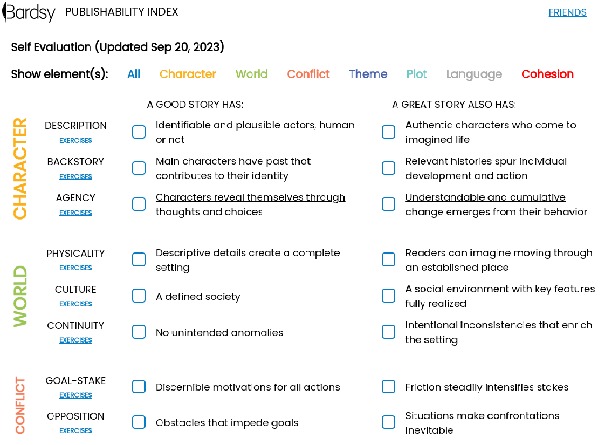
At the top, you'll see that the PI distills much of the conventional wisdom regarding what makes a story great. You're already familiar with the first six elements: character, world, conflict, theme, plot and language. For precision's sake—not to mention comprehensiveness and consistency—the elements are further divided into dimensions. Character, for example, is broken down into description, backstory and agency. To further reach these standards, each dimension also contains two criteria, labeled "good" and "great." Thus, the PI starts with six elements and 18 dimensions, each with two criteria.
Below these six elements, you'll find a new element: cohesion. Though harder to articulate, cohesion is absolutely critical to successful writing. In our research, we found that few guides mention cohesion, let alone discuss it rigorously. The notion behind the cohesion element stems from the truthful cliché that a great story's whole is more than the sum of its parts. To capture this insight, the PI assesses cohesion along five dimensions: environment, veracity, integration, dynamics and resonance. Within each, the criteria call for assessing how well elements synergize.
We find that the PI is easiest to use as a checklist of 23 dimensions and 46 criteria. To evaluate a story, go through the list, dimension by dimension. Read the criteria for each, first “good,” then “great,” asking whether or not that criteria is present or absent. This mode of examination is common to all science-based content analysis because it tends to produce consistent evaluations. After some practice, you'll find that it's also easy to apply, allowing you to answer the question, "How good is my story?"
To illustrate, the character backstory dimension requires that a story's characters have a "past that contributes to their identity" to be considered good. If, after reflection, you determine that this statement is applicable, check this item. If not, move down to the next dimension. On the other hand, if you're able to check off "good," consider the “great" criterion, which is defined as "relevant histories that spur individual development and action." If you're able to check this off, congratulate yourself, and continue your review.
You can see why we think the PI is comprehensive as it stands, because it includes every aspect that underpins great stories. However, feel free to reach out if you think something is missing, and we'll consider it for future editions.
Ultimately, the PI's value can only be found in its utility. We use it, first, to judge Bardsy's story contests. After reading every entry, trained editors move down the list, reflecting, checking boxes and making notes as they go. Entries with lots of checks are invariably better than those with few. Crucially, the “great" checks reliably identify an entry's strengths, freeing the editor to make precise recommendations based on the rest, especially those dimensions where the story hasn't satisfied the "good" criteria.
These recommendations highlight the PI's second use: to provide developmental feedback. A completed PI gives editors a list of an entry's strengths as well as areas that need work. By design, the PI's language lends itself to specific recommendations. To continue the above illustration, if a character "lacks a relevant history that spurs individual development," then that's something an author should seriously consider adding to their story.
In an ideal world, the author's revisions address each concern, leading to another PI-based review. This iterative process would continue until the story receives “great” checks across all 23 dimensions. We consider a story that achieves this success to be eminently publishable. Naturally, this is easier said than done and, empirically speaking, few stories reach this level.
The PI has two more uses. First, you can use the PI as food for thought while you write, and an evaluative tool when you've completed a draft. Second, we find that as our editors and members become familiar with the PI, its dimensions and criteria, they use its terms to discuss the stories they're reading and working on; we'll discuss this second use more in future blogs.
But any tool is worthless if unused. Try the PI out on your latest story to see how well it works for you. And you're welcome to enter our contest to receive the precise, consistent and comprehensive feedback our editors provide.
CLICK A TAB TO USE WILL.POWER
TO DO LIST:
Add tasks to your sortable list, then revel in checking them off.
SCRATCHPAD:
Cache your gems as they fall in this always accessible place.
PRIVATE JOURNAL:
Reflect on your process — good, bad and ugly — in your dated diary.
TRACKING:
Measure your progress with key writing metrics, automatically,
TO DO LIST:
Add tasks to your sortable list, then revel in checking them off.
SCRATCHPAD:
Cache your gems as they fall in this always accessible place.
PRIVATE JOURNAL:
Reflect on your process — good, bad and ugly — in your dated diary.
TRACKING:
Measure your progress with key writing metrics, automatically,
ADD DO
Show Dones
Metric:
ADD
Words
Minutes
Click anywhere to close / cancel